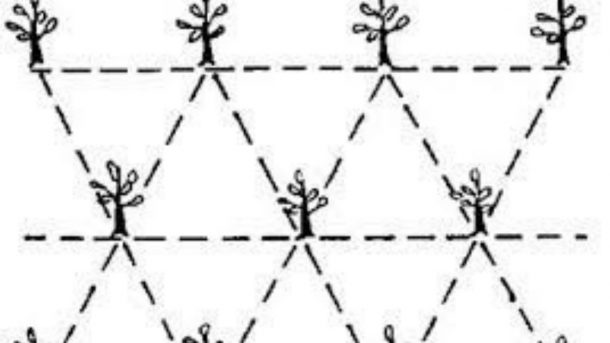
Triangular system is based on the principle of isolateral triangle. The distance between any two adjacent trees in a row is equal to the perpendicular distance between any two adjacent rows. When compared to square system, each tree occupies more area and hence it accommodates few trees per hectare than the square system.
ScientificFarmingWeb
How trees are planted in Diagonal or quincunx system for orange cultivation?
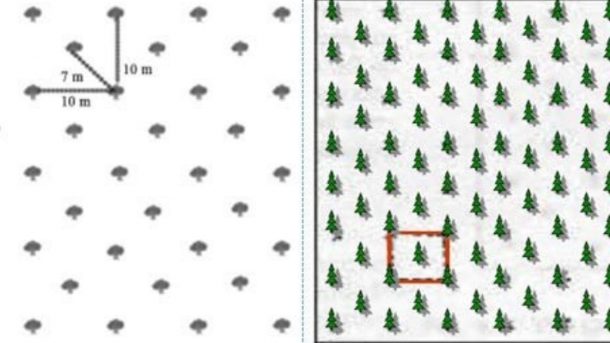
This is the square method but with one more plant in the centre of the square. This will accommodate double the number of plants, but does not provide equal spacing. The central filler tree chosen should be a short lived one and should be removed after a few years when main trees come to bearing. This system can be followed when the distance between the permanent trees is more than 10m.
How trees are planted in hexagonal system for orange cultivation?
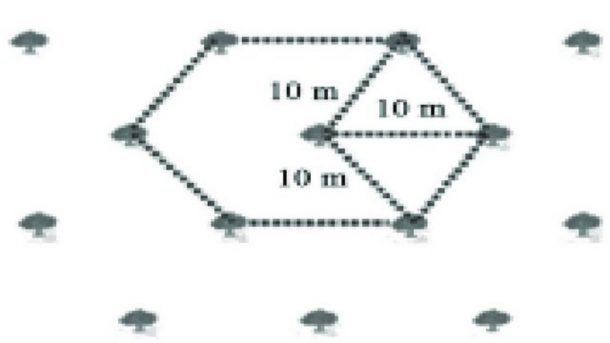
In this method, the trees are planted in each comer of an equilateral triangle. This way six trees form a hexagon with the seventh tree in the centre. Therefore, this system is also called as ‘septule’ as a seventh tree is accommodated in the centre of hexagon. This system is difficult to layout and for doing cultural operations. This system accommodates 15% more trees than the square system.
How trees are planted in rectangular system for orange cultivation?
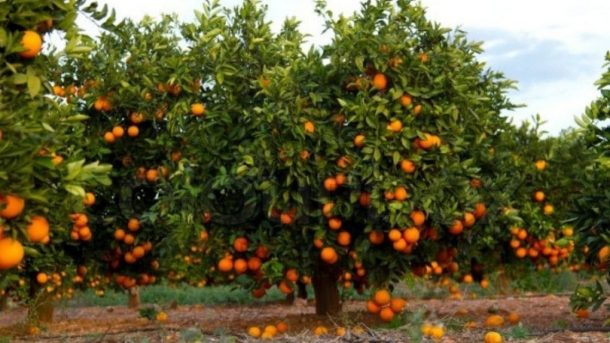
In this system, trees are planted on each corner of a rectangle. The distance between any two rows is more than the distance between any two trees in a row. The wider row spaces permit easy intercultural and mechanical operations.
How trees are planted in square system for orange cultivation?
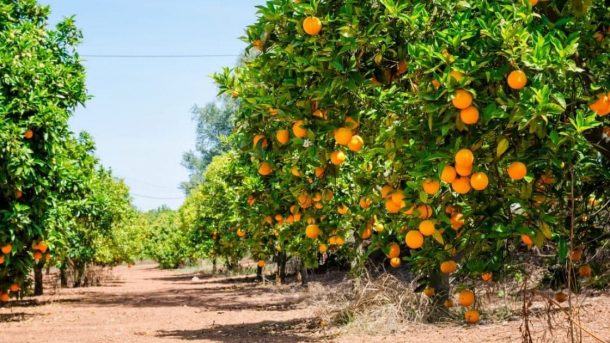
In this system, trees are planted on each comer of a square whatever may be the planting distance. This is the most commonly followed system, easy to layout and permits inter cropping and cultivation in two directions The central place between four trees may be advantageously used to raise short lived filler trees.
How Degassing is done in RAS fish farming.
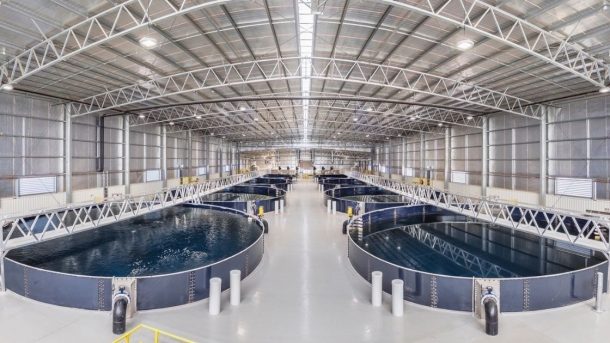
Accumulated gases in the fish tank should be cleared by providing proper aeration and this method is called stripping. Respiration of fish produces carbon dioxide and bacteria in the biofilter produces nitrogen, both of these are the harmful to the growth of the fish. If it is a saltwater tank, then there is a chance of hydrogen sulphide production, which is equally toxic to the fish. Supplying air into the tanks can drive the gases away through turbulence. A trickling filter system is often used for this process. When water is made to flush down from the top of the filter through the plastic media stacked in a column it increases turbulence and contact which helps in stripping the gases.
How aeration or oxygenation in RAS fish farming occurs?
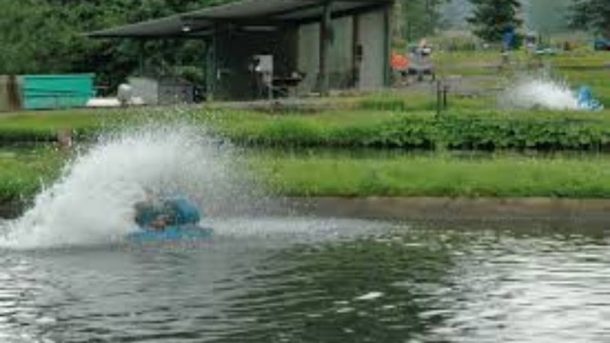
Providing oxygen supply to the water in the tanks is called aeration. Warm and cool water recirculating systems need 6 and 8 ppm of oxygen respectively for bacteria and fish to survive. RAS tanks which have high load carrying capacity should be able to replace oxygen every 20 and 30 minutes. There should be proper and regular supply of oxygen otherwise it could lead to loss of fish and also there should be a backup arrangement for large recirculating systems. Blowing air through a submerged air stone is the commonly used method to aerate the tank. For one pound of food supplied to the fish, the amount of air required is around 187 lpm/kg/day approximately. Diffuser hose and airlifts are devices used for the aeration process. When aeration is provided sufficiently then there is no need for a distinct carbon dioxide stripping unit.
How sump is useful in RAS fish farming?
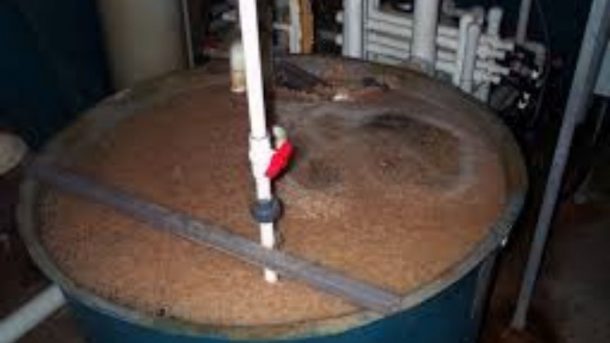
The presence of waste in the tank increases the demands for oxygen and decreases the amount of dissolved oxygen content in water, thereby lowering the density of fish in the tank. A sump or a clarifier tank is used to collect the excess waste at a slow rate. The main idea of the sump is to collect and sediment all the solid waste which could otherwise the block the biofilter and use up the oxygen. This is isolated from a fish tank and should be periodically cleared. The shape of the sump should be ‘v’, so as to facilitate for easy cleaning.
What are the two major categories of Biofilters in RAS fish farming?
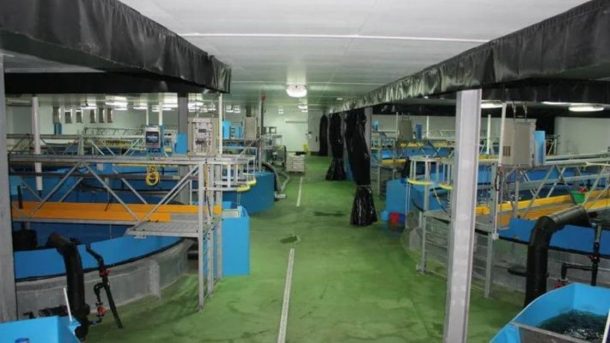
The two major categories of biofilters are submerged bed filters, which need aeration before and after the water passes through them. Emerged bed filters which have constant oxygen supply to support the process and these are of two types namely Trickling filters and rotating biological contractors.
What is the biofilters of RAS fish farming?
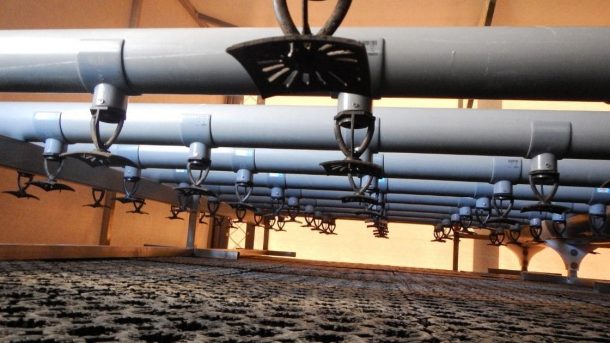
This is the most important component of RAS because it helps in removing the fine pollutants from water during waste treatment. The media within the filter is made up of materials like plastic sheets, beads, lava rock, gravel or sand grains. The properties of the media should be such that it should have a high surface area for bacterial growth, pores of movement of water, clog resistant and should be easy to clean.
A simple biofilter can be a wheel, barrel or box filled with media on which nitrifying bacteria grow. It can be made of plastic, wood, glass, metal or concrete. The size of the biofilter defines the fish carrying capacity of the entire system. The surface area of the filter should be large so as to accommodate high- density bacteria to process loads of waste present in the fish tank. While designing biofilters the surface areas, ammonia loading and hydraulic loading should be properly estimated.