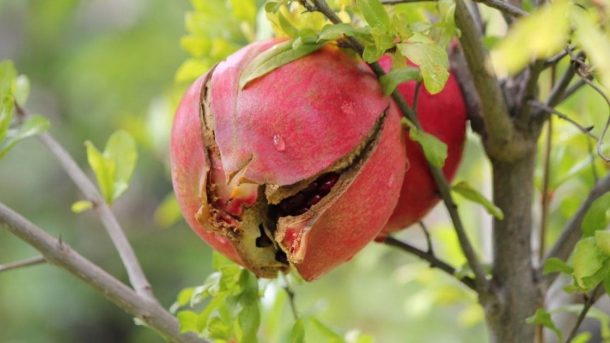
It is major problem in pomegranate under arid and semi-arid regions and about 25-60% fruit cracking has been reported during maturity in different bazar. It also varies with variety, season and climate. The cracked fruits are sweeter with low keeping quality; highly liable to fruit rot and are unfit for transport. In fruit cracking, xylem and phloem tissue loss their ability to divide and enlarge. In summer, after dry spell (April-June) water supply is increased and meristematic tissue quickly resume growth but due to uneven growth rate fruit splitting occurs. while during winter fluctuating moisture and temperature causes cracking. Dry hot wind at the time of fruit ripening is the main cause of cracking during ambe bahar, rapid aril growth, temperature higher than 38°C combined with less than 60% humidity favoured cracking. Nutrients like boron, calcium, copper, zinc, molybdenum, manganese and potash are involved in different physiological activities during fruit growth and development. Deficiencies of nutrients along with imbalanced use of nutrients also cause cracking. In young orchard, fruit cracking is due boron deficiency while in old orchard moisture imbalance and fluctuating temperature are major factor associated with fruit cracking. Fruits split generally when rains come or irrigation is given after a long dry spell. For cracking management apply adequate and regular irrigation during fruiting season. Spray of gibberellic acid @ 20 ppm, calcium chloride 2% and boron 0.2% at fruit enlargement and 1 month before harvest can help in reduce cracking. Cover fruits with bags in hot dry period and maintain sufficient calcium and potassium levels as per soil test report.
ScientificFarmingWeb
Is Epsom salt Good for Banana trees?
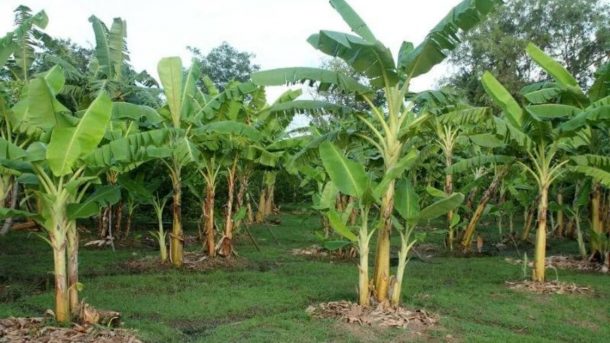
Epsom salts are very beneficial for healthy banana plant growth. It helps in the production of green, abundant leaves and abundant fruits.
How crop nutrition effect on Banana yield?
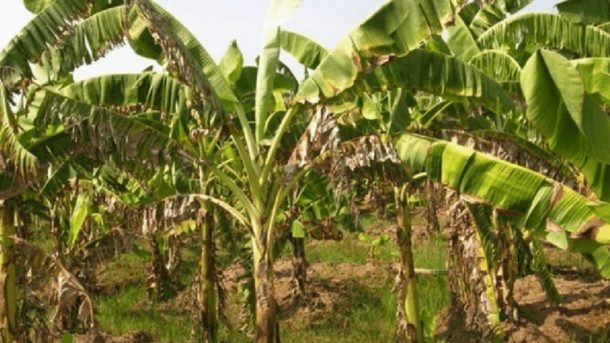
Nitrogen and potassium are key elements in leaf growth, pseudo stem and sucking growth, flower maximization, Banana Fruit set and fill as well production capacity. However, excessive use of nitrogen can weaken the pseudo stem, increasing the risk of storm damage and bunch drop. Too much potassium can lead to calcium and magnesium deficiency and can reduce banana production.
Potassium has a major effect on banana production, which is in demand around flowers. Phosphorous is important for skin growth and root formation as well as for flower and banana fruit sets. Calcium is needed to ensure root, leaf and sucking growth thus yielding high yields. Its effects are most important in ensuring high yielding fruit with long term storage capacity.
Nutritional sprays to increase fruit quantity. Immediately after flower stalk emergence, spraying a mixture of 2 % urea and potassium dihydrogen phosphate helps to increase the number of bunches and fruits.
How much distance of spacing in banana helps to get good bunch weight and quality?
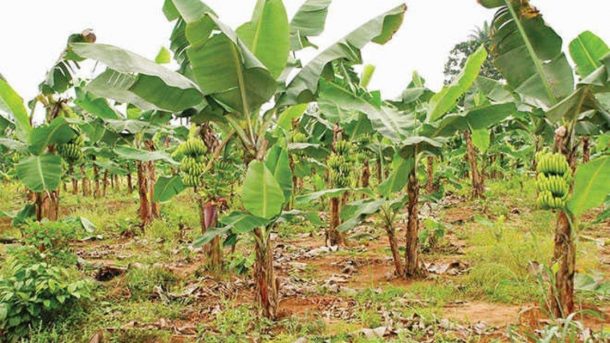
At a spacing of 1.8×1.8 meters, place two plants per hole to double the yield with little or no effect on the size and maturity of the bunch on the crop in Dwarf Cavendish. Double planting of Robusta Bananas also increased profits. Calcium is needed to ensure root, leaf and sucking growth, thus providing high yields.
Which is the best climate for fruit production in banana?
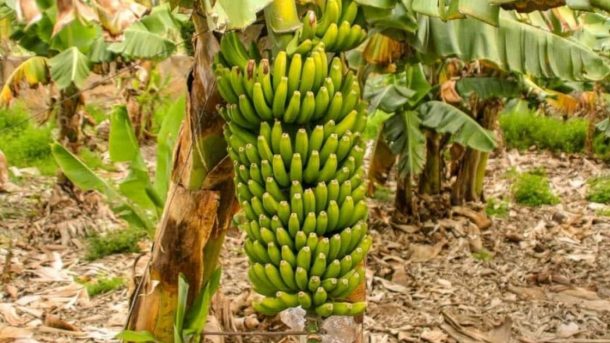
Bananas need a warm, humid and rainy climate as a tropical crop. The maximum temperature range is 10 to 40 °C and the relative humidity is 90% or higher. It is very sensitive to cold and cannot tolerate dry conditions. Strong dry winds cause a significant decline in plant growth and fruit production and quality.
How soil preparation is done for encouraging Banana flowering?
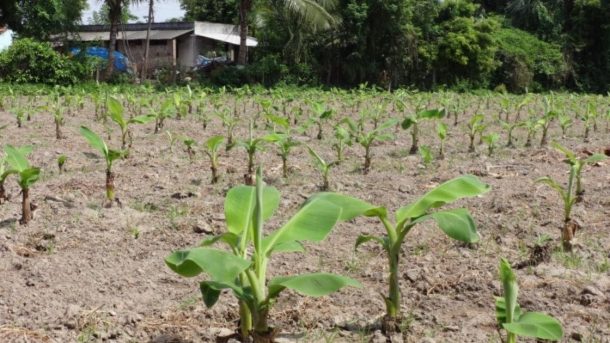
Use soil that is well drained, rich and well nourished to feed your plant. It is important to provide at least 12 hours of sunlight to encourage growth, flowers and fruit. Water banana plant regularly, thoroughly and deeply to keep the soil moist. Bananas can grow from the poorest to the richest type of soil with different successes.
Avoid low lying soil, very sandy and heavy black cotton with poor drainage. Soils that are high in acid and not too alkaline, rich in organic matter with high nitrogen, adequate levels of phosphorus and abundant potash are good for bananas.
How thrips cause damage in banana and how it can be managed?
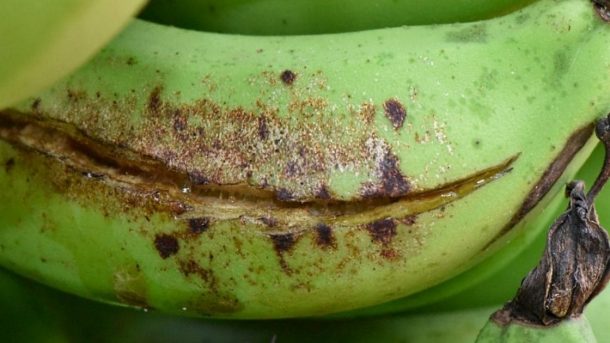
It causes silvery patches on the fruits that later turn brown. The skin of heavily infested fruit may crack permitting secondary infection which results in fruit rot making it unattractive hence lowering its marketability. It can be controlled by removal of male flowers, Covering of bunches/bagging, Use of insecticides, such as – Deltamethrin (Decis 2.5 EC®) – Pirimiphos-Methyl (ACTELLIC 25EC®).
Which is the most damaging pest in banana and how it can be controlled?
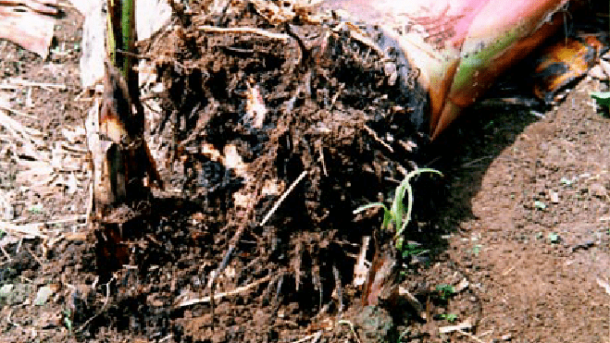
Nematodes are the most damaging pests causing over 70 % loss of the crop. It causes lesions and tunnels within the rhizome. Root destruction leads to toppling of mature plant, especially when the wind blows or during bearing stage. It can be controlled by Use of clean planting material (Tissue Culture or by hot water treatment), use “Tithonia” and “Mexican Marigold” in banana farm as green manure. Apply farmyard manure or poultry manure. Use of nematicides such as Azadirachtin (Achook®), Ethoprophos (MOCAP GR 10®).
Why bunch covering is done in banana?
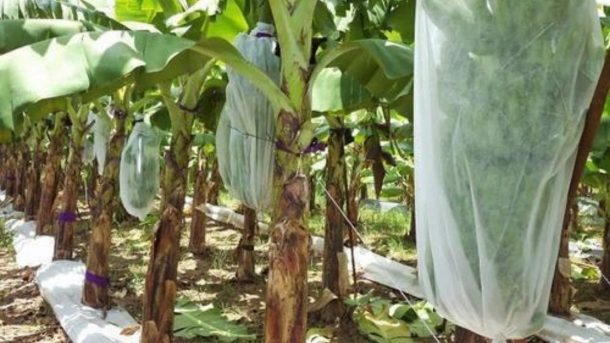
Bagging (bunch covering) is a cultural technique used by planters where export quality bananas are grown. This practice protects bunches against cold, sun scorching, against attack of thrips and scarring beetle. It also improves certain visual qualities of the fruits. Bunch covering with dry leaves is a common practice in India.
What is the water requirement for banana?
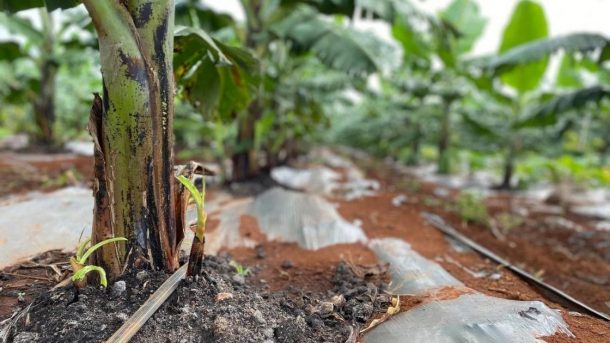
Banana plants require a minimum of 1,000 mm of rainfall annually. Irrigation is therefore necessary where the rainfall received is less than this amount. Water is critical at flowering. Therefore, in drier areas, supplemental irrigation may be necessary during this time 40-60 litres/plant per week split into 20L (in two splits).