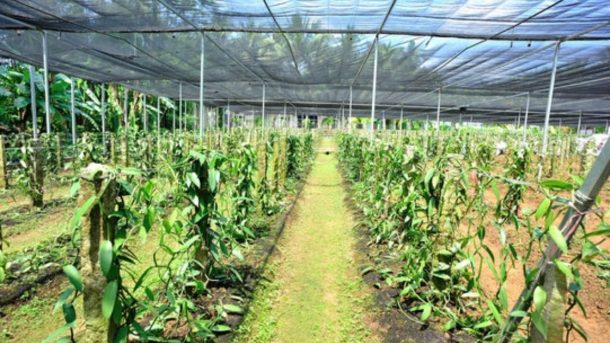
Irrigation is important during the dry & hot summer seasons and also during the first 2 to 3 years of planting. Sprinkler Irrigation is ideal for Vanilla. However, you can also opt for micro irrigation or drip irrigation but water stagnation or flooding should be avoided as the crop is sensitive to these conditions.
ScientificFarmingWeb
How manures and fertilizers are applied in vanilla farming?
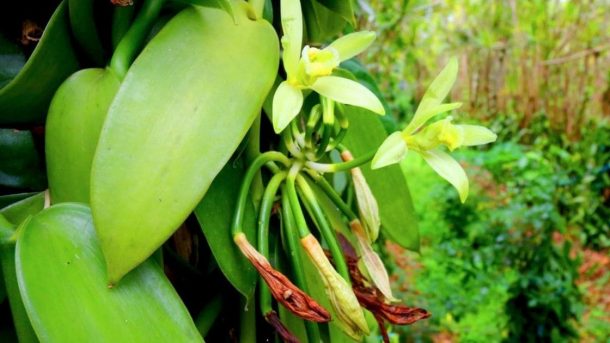
For Vanilla plants, a well composted farmyard manure like cow dung, vermicompost or any organic material such as neem cake is applied. Nitrogen (125 gram) is applied in two split doses in June-July & September-October months. Vermiwash is essential for good growth & yield.
How mulching helps to prevent erosion in vanilla farming?
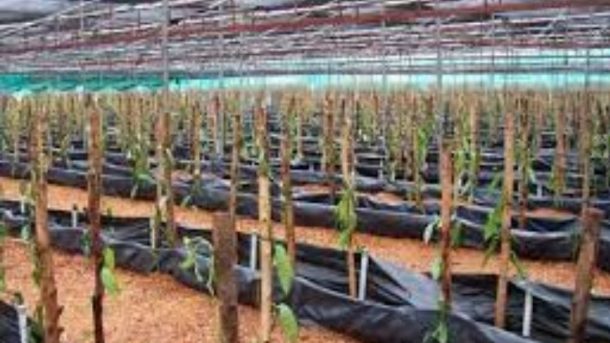
In order to protect the soil from erosion or loss of moisture, mulching is done using dried leaves or coconut leaves or husks and it is also done in order to enrich the soil fertility and weed control.
How pollination occurs in vanilla?
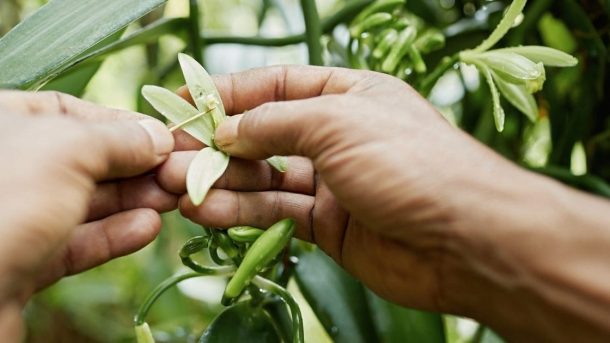
There is an absence of specific pollinating agents so natural self-pollination is not possible, hence artificial pollination is carried out by hand with the help of bamboo splinter, sharpened toothpick or a stiff grass.
The ideal time for pollinating is in the early morning period between 7 a.m. to 12 p.m. and it is preferred to pollinate only the first formed 7-10 flowers on the lower side of the inflorescence. It is recommended to take 5-6 flowers per inflorescence and not more than 10 to 12 inflorescence per vine for pollination. The pods take 6 weeks to attain full size from fertilisation but 4 to 10 months for reaching full maturity depending upon the climatic conditions.
When flowering occurs in vanilla farming?
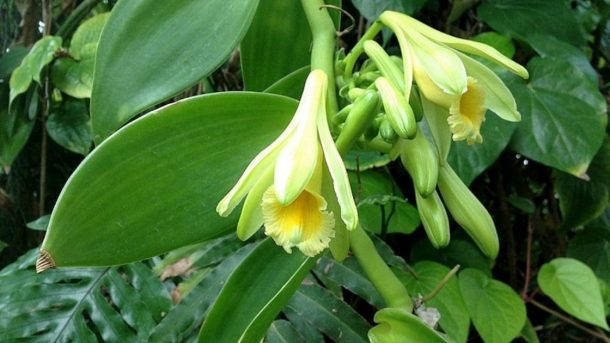
Vanilla plants start to flower from the third year of planting in the month of January and February month but irrigation should be stopped during the month of December and the tips of the vines should be regularly pruned.Abundant irrigation should be provided for inducing more flowers during this stage.
Which micro climate is suitable for vanilla farming?
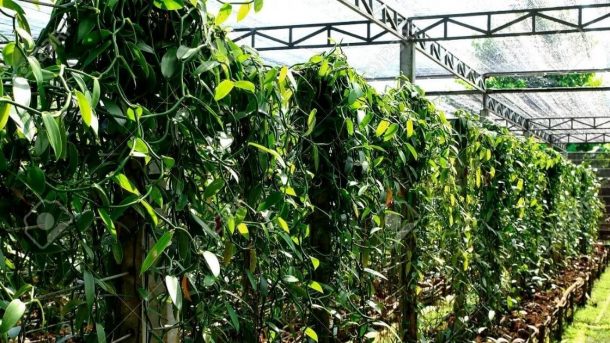
Green houses and shade nets provide a controlled environment for Vanilla plants, thereby producing more yields and this environment provides them the required humidity, light and temperature which are maintained by the essential components.
Any net that provides 60% of shade can be considered as the shade house. The irrigation and humidity requirements are fulfilled using micro sprinklers with both irrigation and misting or fogging facilities that are installed in the shade net house.
How much spacing is maintained for vanilla farming?
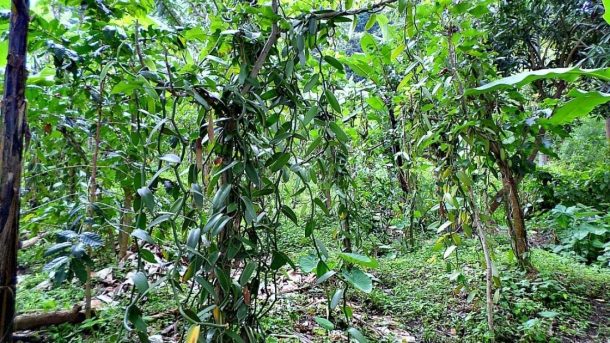
A space of 2.5 to 3 metres is required between the plants and about 2 metres distance between rows and 2 metres distance within the rows, thereby making a population of 1600 to 2000 trees per ha. Vanilla cuttings are planted in rich organic content soil and they are filled in the trenches with the spacing of 8ft and in these trenches 7 feet long support pillars are placed with spacing of 6 feet.
Which is the best time for vanilla planting?
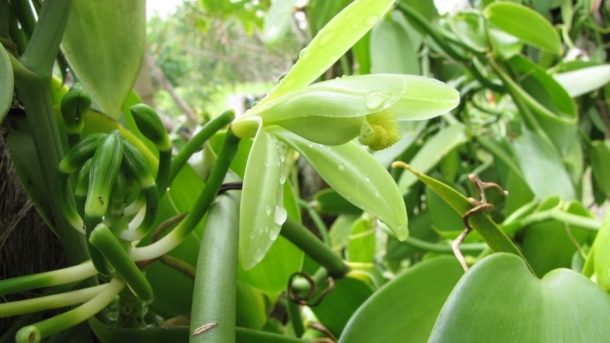
The best time for vanilla planting is the month of August and September, when the weather is not too rainy or too dry. The cuttings of the vine are laid on the soil surface and is then covered with a thin layer of about 2-3 cm soil.
The growing tips are gently tied to the support for climbing by the aerial roots and are covered with dry grass or palm fronds or other suitable materials and if the soil is dry water is sprinkled on them for early establishment of these cuttings.
How propagation is done in vanilla farming?
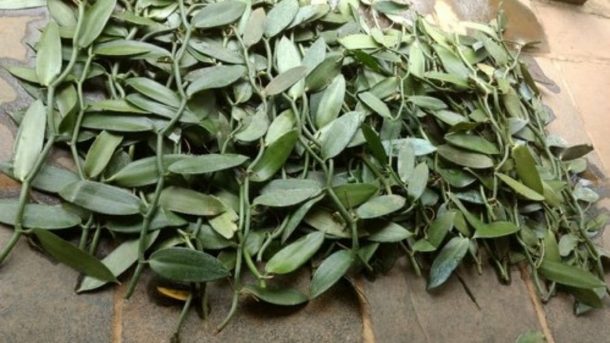
The crop is usually propagated from the cuttings, with the shoot having 18 to 24 internodes for optimal propagation. The cuttings are adjusted depending on the availability of the plant material and the area of the field. However, the cuttings less than 5 to 6 inches or shorter than 60 cm length should be avoided to plant in the main field and for cultivating it in a polybag even 2 nodes of shoot cutting would be enough.
Long cuttings of the shoot start to flower in the second year itself but the short cuttings take three years for flowering. However, long cuttings have slow growth as compared to the shorter ones. Vanilla plants can also be propagated using tissue culture methods. For propagation the leaves of the 4th to 5th node from the tip is removed and the cutting is kept loosely in a shaded place for 2-3 weeks and when it forms a complete root system then it is transplanted to the field.
How land preparation is done for vanilla cultivation?
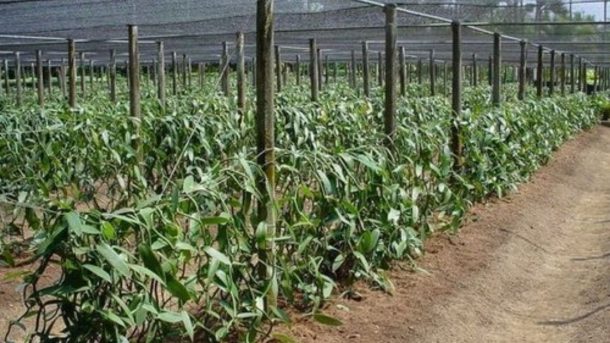
The land is prepared by ploughing it a couple of times to bring the soil to a fine tilth stage and to remove any type of weeds that may have been left from the previous crops. If the soil is not fertile, organic manure is added during the land preparation process. Vanillavines require support for growing, so any type of living trees, rock pillars or iron pillars can be arranged for supporting them.